Alcoholics Anonymous: Definition, How it Works, Principles, Benefits, Alternatives

Alcoholics Anonymous (AA) is a worldwide, peer-led mutual-aid fellowship that assists individuals in achieving and maintaining abstinence from alcohol through a structured recovery framework.
Alcoholics Anonymous works by implementing a community-driven, 12-step approach that emphasizes shared support and individual responsibility for achieving lasting sobriety.
The 12 principles of Alcoholics Anonymous include honesty, hope, faith, courage, integrity, willingness, humility, love, discipline, perseverance, spirituality, and service.
Benefits of Alcoholics Anonymous for alcohol recovery include long-term abstinence, social connections, emotional support, reduced relapse rates, improved self-esteem, better mental health, and spiritual growth. Notably, in Ohio, 16.9% of adults reported excessive drinking, highlighting the importance of support systems like AA.
Alternatives to Alcoholics Anonymous include medication-assisted treatment, partial hospitalization, intensive outpatient programs, behavioral therapies, and support groups like SMART Recovery, LifeRing, Women for Sobriety, and Moderation Management.
What is Alcoholics Anonymous?
Alcoholics Anonymous (AA) is a global, peer-led mutual-aid fellowship focused on supporting individuals in achieving and maintaining abstinence from alcohol through a structured recovery model. The acronym “AA” stands for Alcoholics Anonymous, reflecting its mission to provide anonymity to members while addressing alcoholism. The name “Alcoholics Anonymous” emphasizes humility and privacy: members often introduce themselves by first name only, and anonymity protects their identities, fostering a safe environment for recovery.
According to Krentzman, A. R.’s 2010 study, ‘How Alcoholics Anonymous (AA) and Narcotics Anonymous (NA) Work: Cross-Disciplinary Perspectives, ’ Alcoholics Anonymous (AA) has two million members worldwide. The attrition rates are significant, with 91% of AA attendees and 85% of NA attendees stopping participation for at least a month.
Despite this dropout rate, AA doubles abstinence rates among participants. Clients rated AA’s importance to recovery at 8.7 out of 10 and its helpfulness at 8.02 out of 10.
Attending three or more meetings weekly leads to complete abstinence, while even 1-2 weekly meetings substantially increase abstinence. Among the 1.9 million people with substance addiction, only 18% have alcohol-only dependency and 36% have drug-only dependency, with the remainder having polysubstance issues.
Did you know most health insurance plans cover substance use disorder treatment? Check your coverage online now.
More Resources on Addiction:
What is the history of Alcoholics Anonymous?
The history of Alcoholics Anonymous (AA) traces back to 1935 when Bill Wilson, a New York stockbroker, and Robert Smith, an Akron surgeon, met in Akron, Ohio. Both men struggled with alcoholism and aimed to help others facing similar challenges, leading to the creation of a peer-led support network focused on shared experiences and mutual aid.
The 12-step program became central to AA’s mission, promoting self-reflection, accountability, and communal healing for achieving and maintaining sobriety. The publication of the “Big Book” in 1939 outlined the 12 steps and established anonymity as a key principle to protect members’ identities and encourage humility.
Over the years, AA has grown into a global movement, offering free and accessible support to millions seeking recovery from alcoholism.
How Does Alcoholics Anonymous Work?
Alcoholics Anonymous works by utilizing a peer-led, 12-step program that emphasizes mutual support, personal accountability, and behavioral change to achieve long-term sobriety. Members attend regular meetings where they share experiences and challenges, fostering a nonjudgmental community that reduces isolation and reinforces commitment to recovery. The program’s structure encourages participants to acknowledge their addiction, make amends for past harms, and engage in ongoing self-reflection, which aligns with therapeutic principles of cognitive and behavioral change.
According to Kaskutas L. A.’s 2009 study, ‘Alcoholics Anonymous effectiveness: faith meets science, ’ individuals who attend AA have twice the abstinence rates compared to non-attenders. Specifically, 40-50% of AA attendees achieve abstinence versus 20-25% of non-attendees.
Weekly 12-step group participants show 70% abstinence rates at 2-year follow-up. Long-term attendance produces significant results, with 70% of those attending AA for 27+ weeks per year remaining alcohol-free at 16-year follow-up.
AA-only participants maintain 50% abstinence rates at 1, 3, and 8-year follow-ups. The effectiveness of AA participation translates to a medium-sized statistical effect of 0.5, demonstrating a clear dose-response relationship between meeting frequency and successful sobriety outcomes.
What Are The 12 Principles Of Alcoholics Anonymous?
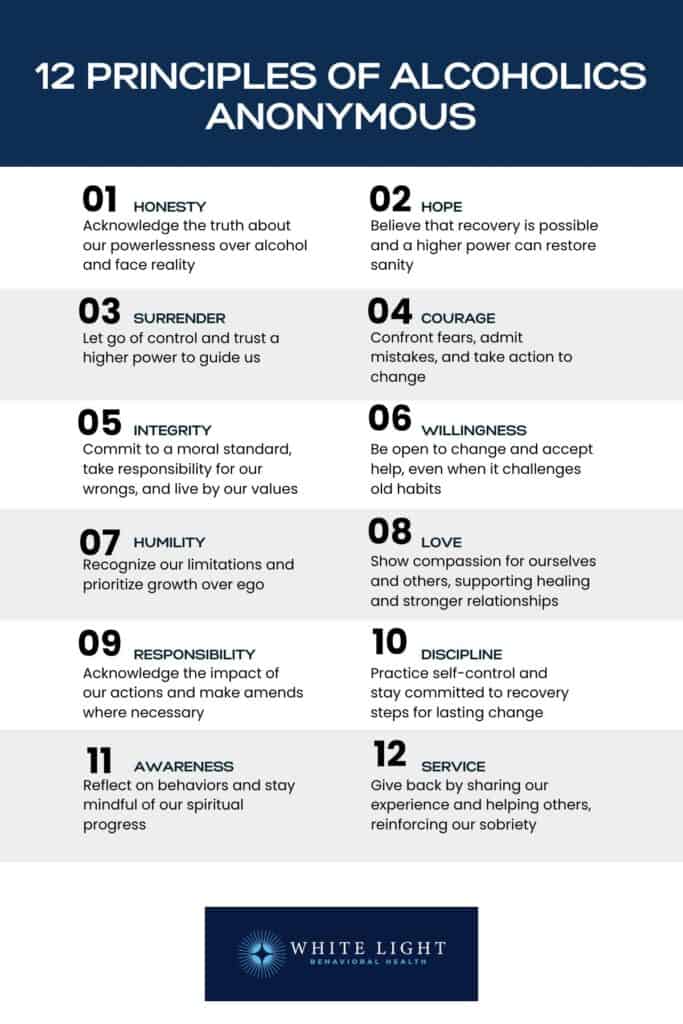
The 12 principles of Alcoholics Anonymous are honesty, hope, faith, courage, integrity, willingness, humility, love, discipline, perseverance, spirituality, and service. These fundamental values guide recovery, including truthful self-assessment, belief in restoration, surrender to a higher power, bravery to face mistakes, moral consistency, openness to change, recognition of limitations, compassion for others, self-control, persistent commitment, continuous reflection, and giving back to fellow alcoholics.
Here are the 12 principles of alcoholics anonymous in detail below:
- Honesty: Embracing a truthful self-assessment by admitting our powerlessness over alcohol and facing reality without denial.
- Hope: Holding a steadfast belief that recovery is achievable and that a power greater than ourselves restores our sanity.
- Surrender: Letting go of personal control and turning our will and lives over to a higher power, as we understand it.
- Courage: Finding the bravery to confront our fears, acknowledge past mistakes, and take the necessary steps for change.
- Integrity: Committing to a consistent moral standard by owning our wrongs and striving to live according to our values.
- Willingness: Remaining open and ready to accept help and change, even when it challenges long-held habits.
- Humility: Recognizing our limitations and the need for assistance, putting principles before ego for genuine growth.
- Love: Cultivating compassion for ourselves and others, which supports making amends and building stronger relationships.
- Responsibility: Acknowledging the impact of our actions on others and taking ownership by making necessary amends.
- Discipline: Practicing self-control and maintaining a steady commitment to the steps for long-term recovery.
- Awareness: Continuously reflecting on our behaviors and attitudes, staying alert to our thoughts as we progress spiritually.
- Service: Giving back by sharing our experience, strength, and hope with others, reinforcing our sobriety while helping fellow alcoholics.
What Are The 12 Traditions Of Alcoholics Anonymous?
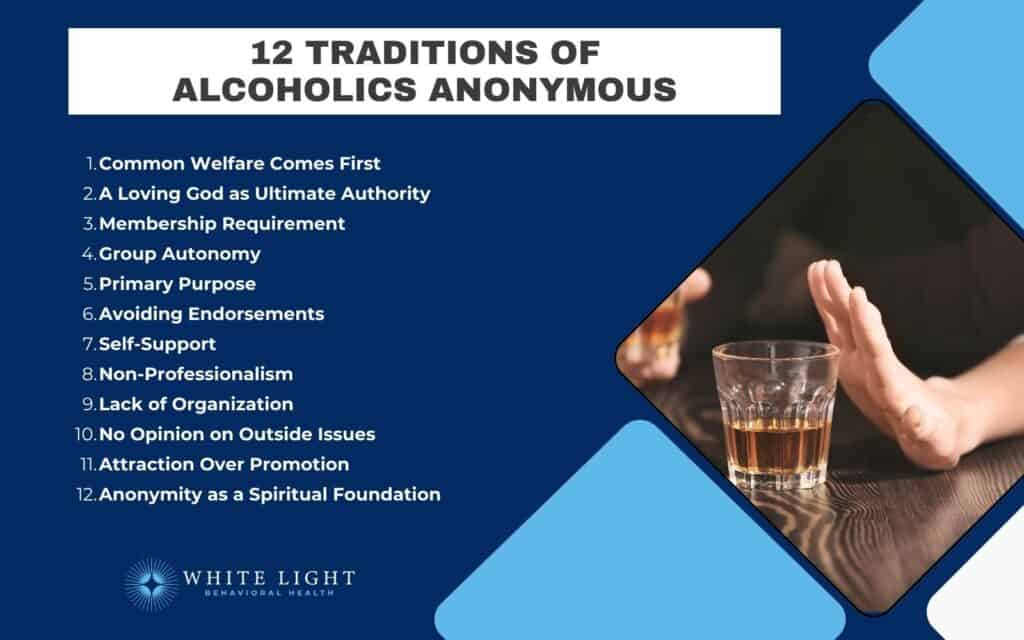
The 12 traditions of Alcoholics Anonymous are Unity, Group Conscience, Membership, Autonomy, Primary Purpose, Non-Affiliation, Self-Support, Non-Professionalism, Organization, Outside Issues, Public Relations, and Anonymity. These guiding principles ensure group unity, maintain focus on recovery, and preserve the organization’s spiritual foundation. They emphasize common welfare, higher power guidance, inclusive membership, group autonomy, and carrying the message to suffering alcoholics.
See the complete list of 12 AA traditions below:
- Common Welfare Comes First: Personal recovery depends on AA unity, prioritizing the well-being of the group as a whole.
- A Loving God as Ultimate Authority: For group purposes, decisions are guided by a higher power expressed through group conscience. Leaders act as trusted servants rather than governors.
- Membership Requirement: The only requirement for AA membership is a desire to stop drinking, ensuring inclusivity.
- Group Autonomy: Each group is autonomous except in matters affecting other groups or AA as a whole, allowing flexibility in governance.
- Primary Purpose: Every group’s primary goal is to carry its message to alcoholics who still suffer, focusing on outreach and service.
- Avoiding Endorsements: Groups do not endorse or affiliate with outside enterprises to prevent distractions from their primary mission.
- Self-Support: AA groups are fully self-sustaining and decline outside contributions to maintain independence.
- Non-Professionalism: While AA remains non-professional, service centers employ workers for administrative tasks.
- Lack of Organization: AA avoids formal organization but allows service boards or committees directly responsible to those they serve.
- No Opinion on Outside Issues: AA remains neutral on external controversies to avoid being drawn into public disputes.
- Attraction Over Promotion: Public relations focuses on attraction rather than promotion, maintaining personal anonymity in media interactions.
- Anonymity as a Spiritual Foundation: Anonymity reminds members to place principles before personalities, fostering humility and unity.
What Are The Benefits Of Alcoholics Anonymous?
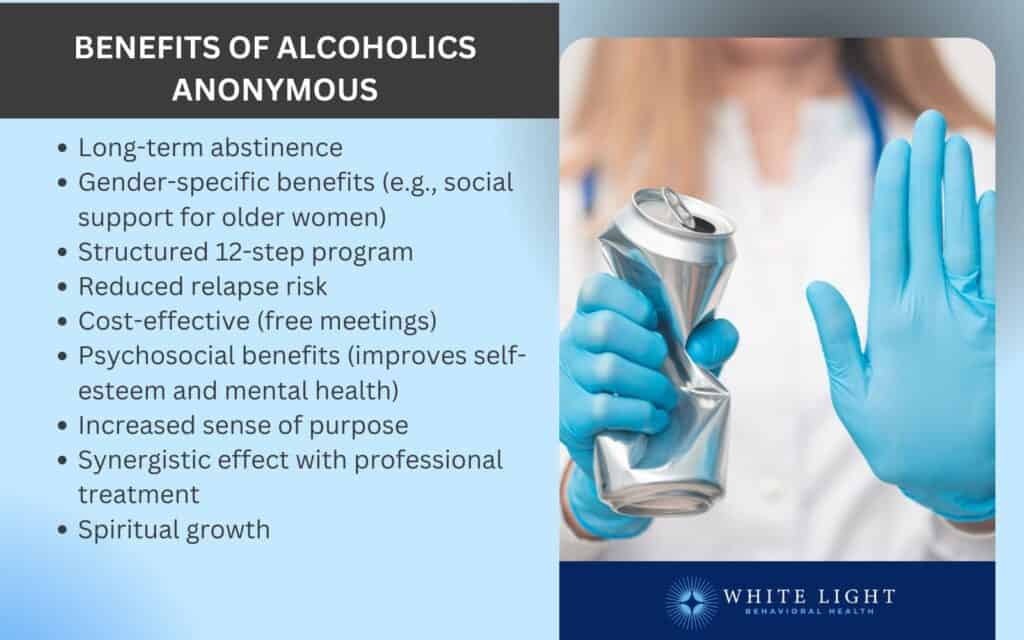
The benefits of Alcoholics Anonymous include long-term abstinence, enhanced social connections, emotional support, reduced relapse rates, improved self-esteem, better mental health, cost-effectiveness, personal development, a renewed sense of purpose, increased effectiveness of professional treatment, and spiritual growth.
Here are the key benefits of alcohol anonymous:
- Long-term Abstinence: AA is effective in helping individuals maintain long-term sobriety by providing ongoing support and a community of peers who understand the challenges of recovery. According to Kelly, J. F.’s 2020 study, ‘Alcoholics Anonymous and 12-Step Facilitation Treatments for Alcohol Use Disorder: A Distillation of a 2020 Cochrane Review for Clinicians and Policy Makers.’, Alcoholics Anonymous is the oldest and largest recovery support service for alcohol use disorder (AUD).
In North America, AA is the most commonly sought source of help for AUD. A 2020 Cochrane review that included 27 studies with 10,565 participants found that AA/TSF interventions performed at least as well as established treatments on all outcomes, and outperformed other treatments for continuous abstinence and remission. AA/TSF interventions demonstrated higher healthcare cost savings than other AUD treatments.
AA attracts a diverse membership of women and men from a wide range of racial and ethnic backgrounds. AA meetings typically last 60-90 minutes and are usually held in rented local accommodation such as churches, synagogues, hospitals, community centers, and colleges.
- Different Benefits for Men and Women: While both men and women benefit from AA, older women often experience unexpected social benefits, such as enhanced social connections and emotional support.
According to Ermann, L. S.’s 2016 study, ‘Unexpected social benefits of Alcoholics Anonymous for older women, ’ older women in Alcoholics Anonymous receive unexpected social benefits beyond sobriety. The study interviewed participants about their most meaningful experiences and found that AA provides valuable social connections that address the specific needs of older women.
These benefits align with Carstensen’s socioemotional selectivity theory and demonstrate that recovery programs offer multi-dimensional advantages beyond maintaining sobriety.
- Structured Program: The 12-step program offers a clear and structured approach to recovery, helping individuals understand and address their addiction systematically.
- Less Chance of Relapse: Participation in AA reduces the likelihood of relapse by providing a supportive network and strategies for coping with triggers. According to McCrady, B.’s 2004 study, ‘Alcoholics Anonymous and relapse prevention as maintenance strategies after conjoint behavioral alcohol treatment for men: 18-month outcomes.’, AA attendance directly improved abstinence outcomes.
Participants maintained sobriety on 80% of days during the 18-month follow-up period. Those in the AA-focused treatment attended meetings more frequently and showed stronger connections between AA participation and reduced drinking.
AA attendance positively correlated with abstinence in both immediate timeframes and subsequent periods. The data demonstrated that regular participation in posttreatment support activities, whether through AA meetings or booster sessions, increased abstinence rates.
- Cost-Effective: AA meetings are free, making them a cost-effective option for those seeking help with alcohol use disorder.
According to Kelly, J. F.’s 2021 study, ‘Leave the Past Behind by Recognizing the Effectiveness and Cost-Effectiveness of 12-Step Facilitation and Alcoholics Anonymous, ’ Alcoholics Anonymous (AA) and 12-Step Facilitation (TSF) treatments demonstrated superior cost-effectiveness compared to alternative alcohol use disorder treatments. The updated Cochrane Review analyzed data from more than triple the number of research participants compared to the previous 2006 review.
AA is a free program available globally, making it a cost-effective public health intervention.
- Psychosocial Benefits: AA participation improves self-esteem, social confidence, and overall mental health. According to Frings, D.’s 2019 study, ‘Tales of hope: Social identity and learning lessons from others in Alcoholics Anonymous: A test of the Social Identity Model of Cessation Maintenance, ’ social identity within AA directly correlates with improved recovery outcomes.
The study shows that 170 AA members (average age 45.4 years, 50% male) who strongly identified with AA reported higher story relevance, utility, quit efficacy, and perceived cost of relapse. Social connections with non-using individuals lead to better post-treatment outcomes across substance use disorders.
AA’s shared narratives (“tales of hope”) serve as contextual frameworks that increase members’ recognition of personal costs of relapse, such as damaged relationships and lost abstinence. The research confirms that higher identification with recovery groups relates to more positive cessation maintenance, supporting the Social Identity Model of Cessation Maintenance (SIMCM).
- Increased Purpose in Life: Alcoholics Anonymous (AA) meetings serve as a transformative platform for individuals seeking a renewed sense of purpose.
Participants engage with a community that encourages introspection on personal values and life direction. The AA program emphasizes personal development and accountability, guiding members towards a meaningful existence.
This engagement often prompts a reevaluation of individual goals and the impact one desires to have on their own and others’ lives. As a result, attendees frequently adopt a more deliberate and purpose-driven approach to their daily lives, fostering a deeper sense of meaning and fulfillment.
- Synergistic Effect with Professional Treatment: Combining AA with professional treatment has a synergistic effect, enhancing recovery outcomes.
- Spiritual Growth: For many, AA provides a path to spiritual growth and personal transformation, a powerful motivator for sustained recovery.
According to Krentzman, A. R.’s 2017 study, ‘Decreased Drinking and Alcoholics Anonymous are Associated with Different Dimensions of Spirituality, ’ AA involvement directly increased four dimensions of spirituality: positive religious coping, daily spiritual experiences, forgiveness of others, and spiritual/religious practices. In contrast, decreased drinking independently raised three dimensions: purpose in life, self-forgiveness, and spiritual/religious practices.
The sample included participants from diverse pathways: 43.1% from university-based treatment, 22.0% from VA treatment, 9.3% from moderation-based programs, and 25.5% from the community.
Contact us today to schedule an initial assessment or to learn more about our services. Whether you are seeking intensive outpatient care or simply need guidance on your mental health journey, we are here to help.
What Are Some Alternative Treatments To Alcoholics Anonymous?

The alternative treatments to Alcoholics Anonymous are medication-assisted treatment, partial hospitalization programs, intensive outpatient programs, behavioral therapies like CBT, and various support groups such as SMART Recovery, LifeRing, Women for Sobriety, Secular Organizations for Sobriety, and Moderation Management.
Here are the common alternative treatments to alcoholic anonymous in detail below:
- Medication-Assisted Treatment (MAT): MAT involves the use of medications, such as naltrexone, acamprosate, or disulfiram, combined with counseling and behavioral therapies. These medications help reduce cravings, block the effects of alcohol, or cause unpleasant side effects if alcohol is consumed, thereby supporting abstinence.
MAT helps manage withdrawal symptoms and reduce the risk of relapse by addressing the biological aspects of addiction.
According to Kirchoff, R. W.’s 2021 study, ‘Naltrexone Initiation in the Inpatient Setting for Alcohol Use Disorder: A Systematic Review of Clinical Outcomes, ’ naltrexone shows promising results for treating Alcohol Use Disorder (AUD). Hospital readmission rates decreased from 23.4% to 8.2% in the Wei study, with an even more dramatic reduction from 26.2% to 2.8% among patients counseled about naltrexone in the Stephens study.Emergency department revisits also dropped from 18.8% to 6.1% in one study, and patients counseled about naltrexone before discharge had 79% lower odds of returning to the ED.
- Partial Hospitalization Program (PHP): A PHP offers a structured treatment environment for several hours a day, multiple days per week. It includes therapy, counseling, and educational sessions.
PHP is designed for individuals who need more intensive support than traditional outpatient programs but do not require 24/7 supervision. It provides a step-down approach from inpatient treatment, allowing individuals to continue their recovery while living at home.
According to Blevins, C. E.’s 2017 study, ‘Alcohol treatment outcomes following discharge from a partial hospital program.’, 69.7% of participants (62 out of 89) remained abstinent during the one-month follow-up period after completing the partial hospital program for alcohol use disorder. The program lasted an average of 7.13 days.
- Intensive Outpatient Program (IOP): IOPs provide a flexible treatment option with scheduled sessions that fit around work or school commitments.
These programs typically involve group therapy, individual counseling, and educational workshops on relapse prevention and coping skills. IOPs offer a supportive environment for individuals transitioning out of inpatient treatment or those who need more support than standard outpatient therapy.
- Behavioral Therapies: Various behavioral therapies, such as Cognitive Behavioral Therapy (CBT), Dialectical Behavior Therapy (DBT), and Motivational Interviewing (MI), are effective in treating alcohol addiction.
CBT helps individuals identify and change negative thought patterns and behaviors associated with alcohol use. DBT teaches skills to manage emotions and cope with stress.
MI enhances motivation to change by exploring ambivalence and building commitment to recovery.
According to Magill, M.’s 2019 study, ‘A meta-analysis of cognitive-behavioral therapy for alcohol or other drug use disorders: Treatment efficacy by contrast condition.’, CBT for alcohol disorders effectively outperformed minimal treatment and showed early benefits compared to non-specific therapies, but these advantages disappeared after 8 months. CBT performed equally to other evidence-based treatments.The review analyzed 30 randomized trials with 15 targeting alcohol specifically, totaling 5,398 participants. Most studies (78%) addressed alcohol dependence with treatment typically delivered over 12 sessions in either individual (53%) or group (44%) formats.
- Support Groups: Besides AA, several other support groups offer alternative approaches.
These include:
- SMART Recovery: A science-based program that uses cognitive and behavioral techniques to help individuals manage their addictive behaviors. According to Manning, V.’s 2023 study, ‘Piloting the integration of SMART Recovery into outpatient alcohol and other drug treatment programs, ’ SMART Recovery groups showed 94% of participants (31 total) achieved reduction or maintained abstinence from substance use.
71% reported improved mental health, 74% better physical health, and 81% increased social connection. The program ran 75 groups averaging 6.5 attendees per meeting.
- LifeRing: A secular, peer-led support group that emphasizes personal responsibility and sobriety.
- Women for Sobriety (WFS): A self-help program designed specifically for women, focusing on emotional growth and positive self-image.
- Secular Organizations for Sobriety (SOS): A non-religious support group that promotes rational thinking and personal responsibility in achieving sobriety.
Secular Organizations for Sobriety (SOS) was established as an alternative for those who object to the religious or spiritual elements found in Alcoholics Anonymous.
- Moderation Management (MM): A program for individuals who want to moderate their drinking rather than abstain completely, although it is not suitable for everyone with alcohol use disorder.
- SMART Recovery: A science-based program that uses cognitive and behavioral techniques to help individuals manage their addictive behaviors. According to Manning, V.’s 2023 study, ‘Piloting the integration of SMART Recovery into outpatient alcohol and other drug treatment programs, ’ SMART Recovery groups showed 94% of participants (31 total) achieved reduction or maintained abstinence from substance use.
Is Alcoholics Anonymous effective?
Yes, Alcoholics Anonymous (AA) is effective in helping individuals achieve and maintain abstinence from alcohol. According to Pfund, R. A.’s 2023 study, ‘Relative and Interactive Associations of Psychosocial Intervention and Alcoholics Anonymous Attendance With Alcohol Use Disorder Outcomes, ’ AA attendance significantly reduced drinking days at 1 and 3 years post-intervention.
Participants attended AA on 11.0% of days during psychosocial interventions, dropping to 7.7% at 1 year and 6.4% at 3 years. AA attendance varied by treatment type, with TSF participants attending on 21.5% of days compared to just 3.8% for CBT and 6.8% for MET participants.
Higher AA attendance consistently predicted a lower percentage of drinking days at 3-year follow-up across all treatment conditions, demonstrating AA’s long-term effectiveness in reducing alcohol consumption.
Who Joins Alcoholics Anonymous?
Anyone who has a desire to stop drinking should join Alcoholics Anonymous (AA). Membership is open to individuals of all ages, genders, ethnicities, and religious or non-religious backgrounds.
AA does not discriminate based on socioeconomic status or personal history; the only criterion for joining is the sincere desire to overcome alcohol addiction. This inclusivity ensures that anyone struggling with alcohol misuse has access to support in a non-judgmental and welcoming environment.
Is Alcoholics Anonymous Free?
Yes, Alcoholics Anonymous is free. There are no dues, fees, or financial obligations for membership. AA operates on voluntary contributions from members to cover meeting expenses, such as venue rentals and refreshments.
However, these donations are optional, and no one is turned away for inability to contribute. This model ensures accessibility for everyone, regardless of their financial situation.
Is Alcoholics Anonymous Religious?
No, Alcoholics Anonymous is not religious but rather has quasi-religious/spiritual elements that play a variable role in recovery depending on individual factors. While its Twelve Steps include references to spirituality and concepts like a “Higher Power,” AA explicitly states that it is not affiliated with any religion or denomination.
According to Kelly J. F.’s 2017 study, ‘Is Alcoholics Anonymous religious, spiritual, neither? Findings from 25 years of mechanisms of behavior change research.’ AA originated with a spiritual emphasis, stating “recovery is achieved through a spiritual awakening.” Scientific studies reveal that AA’s benefits stem primarily from social, cognitive, and affective mechanisms.
Data shows AA helps people by changing social networks and increasing abstinence self-efficacy, with spirituality significant only for those with severe addiction. This reflects AA’s evolution from its original small membership where spiritual awakening appeared central to its diverse modern membership of two million who benefit through multiple pathways.
Is Alcoholics Anonymous Only For Alcoholics?
Yes, Alcoholics Anonymous is specifically designed for individuals struggling with alcohol addiction. Its primary purpose is to help members achieve sobriety and maintain it through mutual support and the Twelve-Step program. However, other Twelve-Step groups exist for individuals dealing with different addictions or compulsive behaviors, such as Narcotics Anonymous (NA) or Overeaters Anonymous (OA), which follow similar principles but focus on other issues.
What Is The Purpose Of Alcoholics Anonymous (AA) 12 Steps?
The purpose of Alcoholics Anonymous (AA) 12 Steps is to provide a structured approach for individuals struggling with alcohol addiction to achieve and maintain sobriety. These steps offer a framework for self-reflection, personal growth, and spiritual development, ultimately guiding members toward recovery and a healthier lifestyle.
Who Started Alcoholics Anonymous (AA)?
Alcoholics Anonymous (AA) was founded in 1935 by Bill Wilson and Dr. Bob Smith, two individuals who struggled with alcohol addiction themselves.
Their shared experiences led them to develop the principles and practices that form the foundation of the AA program. They started Alcoholics Anonymous with the primary goal of helping others achieve sobriety.
How Does Alcoholics Anonymous (AA) Define A “higher Power”?
Alcoholics Anonymous (AA) defines a “higher power” as a concept intentionally left open to individual interpretation. It’s described as any power greater than oneself that provides strength during recovery.
This “higher power” doesn’t need to be the God of any particular religion – be it nature, the universe, the collective wisdom of the AA group itself, or any spiritual concept that resonates with the individual. The essential element is acknowledging that willpower alone isn’t sufficient for recovery, and that surrendering to something beyond oneself is a crucial step in the healing process.
This flexibility allows AA to welcome people of all faiths and those with no religious background.
Rediscover Life at White Light Behavioral Health
Get the compassionate support you deserve. We're here to help you reclaim joy, wellness, and a brighter future.

Can Someone Participate In Alcoholics Anonymous (AA) Without Adhering To A Specific Religious Belief?
Yes, someone participating in Alcoholics Anonymous (AA) without adhering to a specific religious belief. AA is inclusive and welcomes individuals from all religious backgrounds, including those who identify as agnostic or atheist.
While AA does reference a “higher power” in its twelve steps, members are encouraged to interpret this concept in a way that resonates with their own personal values and beliefs. The emphasis is on finding a personal spiritual path rather than following any particular religious doctrine.
How Do Alcoholics Anonymous (AA) Meetings Operate?
Alcoholics Anonymous (AA) meetings operate through a structured format where members share personal experiences, discuss the organization’s 12 Steps, and offer mutual support. These meetings function in two main formats: open meetings that welcome anyone interested and closed meetings restricted to those with a desire to stop drinking. AA meetings operate on principles of anonymity and confidentiality, with fellow members typically leading sessions rather than professional counselors. The operational structure emphasizes peer support, personal responsibility, and a non-judgmental environment where participants freely discuss their struggles with alcohol.
How Does Alcoholics Anonymous (AA) Support Its Members Outside Of Meetings?
Alcoholics Anonymous (AA) supports its members outside of meetings through several essential resources and mechanisms. Members have access to 24/7 phone support networks where they reach out to sponsors or fellow members when facing challenges.
AA provides comprehensive literature, particularly the “Big Book,” which offers guidance and inspiration for daily recovery. Online forums and digital resources allow members to connect virtually between face-to-face gatherings.
Additionally, AA encourages the formation of informal social networks where members build friendships and support systems that extend beyond formal meetings, providing continuous encouragement throughout their recovery journey.
What Are The Key Differences Between AA And NA?
The key differences between AA and NA include their focus and scope: Alcoholics Anonymous (AA) specifically addresses alcohol addiction only, while Narcotics Anonymous (NA) encompasses all substance use disorders, including alcohol. Both organizations follow the same 12-step approach to recovery, but use slightly different terminology and meeting formats. When considering AA vs NA, people typically choose based on their primary substance of addiction and which group’s culture feels more comfortable and supportive for their specific recovery needs.
How Long Has Alcoholics Anonymous (AA) Been Around?
Alcoholics Anonymous (AA) has been around since 1935. Since then, Alcoholics Anonymous has been around as a crucial support system for those struggling with alcohol dependency.
Founded by Bill Wilson and Dr. Bob Smith, AA has grown into a global fellowship with meetings held in nearly every country.
Share This Post

Dr. Ryan Wakim M.D.
All author posts
TREATMENTS WE OFFER
Are you covered for treatment?














White Light Behavioral Health is an approved provider for Blue Shield and Tufts, while also accepting many other major insurance carriers.
Check Coverage Now!